
This year is significant for Sarawak, the country’s largest state, which will pivot from timber as its primary industry toward conservation and tourism as it welcomes the world to its impending status as a UNESCO Global Geopark Site.
The largest forestry area in Malaysia is Sarawak, which holds the largest share of the country’s total forest cover, especially in Borneo. Sabah follows, and Pahang has the largest forest reserves in Peninsular Malaysia, covering vast areas such as the Belum-Temengor complex.
Sarawak’s extensive forests, covering about 62% of its land, are categorised as permanent forest estates for conservation, making it the state with the largest share of forested land.
While, in the past, its fertile trees were valuable for timber concessions, the state is also aware of the importance of conservation and preservation, hence the significant role accorded to the Sarawak Forestry Department.
At the heart of it is the Sarawak Delta Geopark, a geo-heritage area, famous for its 200-million-year-old geological heritage, unique biodiversity, and local culture, offering important sites such as Bako National Park, Santubong National Park, and Dered Krian National Park, making it prime for hiking, nature exploration, and understanding Sarawak’s earth history.
It is complemented by attractions such as Bako National Park, Santubong National Park, Dered Krian National Park, Wind Cave & Fairy Cave Nature Reserve, as well as stunning waterfalls and limestone formations.
This year, Sarawak Delta is poised to join Langkawi and Sabah’s Kinabalu as UNESCO-accredited global geoparks – one of over 200 of its kind in 50 countries.
It is a global network that underscores sustainability and showcases the integration of tourism, geology, and forestry.
A geopark is a protected area with significant geological heritage (sites of scientific, rarity, or aesthetic value) that is managed holistically for protection, education, and sustainable development, integrating geology with cultural and natural heritage for community benefit, often through geotourism.
It’s not just about rocks; it’s a unified concept that links Earth’s history to local identity, economies, and modern issues such as climate change, using a bottom-up approach with strong community involvement.
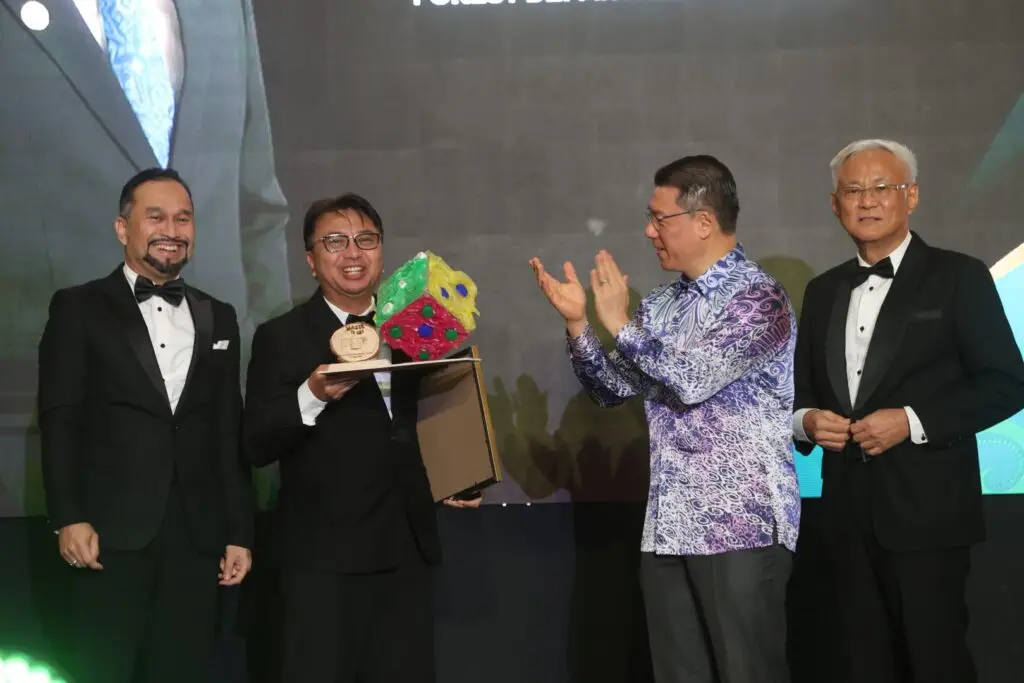
In an exclusive interview in conjunction with the inaugural Green and Geopark Excellence Awards (GAGA), during which Sarawak Forestry won two awards, its director, Datu Hamden Mohammad, outlined the roadmap ahead.

“We are no longer just about timber. We are advocating a significant focus on conservation and preservation. We will also be replanting our trees.”
Hamden’s remarks stand in contrast to decades earlier, when logging had brought the state into the international limelight, especially when a Swiss-born environmentalist, Bruno Manser, went missing in the state’s dense jungle cover.
Sarawak is now shifting its focus from timber extraction to forest conservation and the development of environmentally based revenue streams, Hamden declared.
Hence, he is grateful for the recognition of the GAGA awards, which showcased the department’s aim to become an example in sustainability.
He said that greater recognition would spur Sarawakians to collaborate with the public and private sectors to showcase the state’s forests and geoparks in their natural form, rather than redeveloping them.
With UNESCO recognition coming on stream soon, Hamden said Sarawak is now awaiting the opportunity to tell the world that it is more about sustainability than just the traditional practice of felling trees for wood and revenue.
“This shift was crucial, as Sarawak moves to transform its forestry sector through more sustainable and technology-driven methods, in line with the post-COVID-19 development strategy 2030. Sarawak is no longer primarily reliant on logging as its main source of income.”
The shift will include eco-tourism, the geopark’s main feature.
“More than 50 years ago, timber was the state’s main source of income. However, we are now prioritising forest conservation and looking for new ways, such as carbon trading and payment for services that do not affect the existing ecosystem,” he said.
Sarawak, with a total land area of 12.4 million hectares, still retains 62 per cent forest cover and, as part of its commitment to conservation, aims to gazette 6 million hectares as permanent forest reserves and one million hectares as totally protected areas (TPAs).
The forestry authority was also reportedly investing in advanced monitoring technology, with one key initiative involving a collaboration with Japan’s National Institute of Science and Technology (NIST) through a Memorandum of Understanding signed in 2024.
“Technology from Japan, such as satellite monitoring that can detect climate change and natural disasters early, is being studied for application in Sarawak.
“We have sent researchers and experts to collaborate with NIST, and I will lead a delegation to Japan to assess the progress of this collaboration,” said Hamden.
The Sarawak Forest Department is a leading authority on sustainable forest management, with a focus on conservation, rehabilitation, and sustainable practices.
It is distinct from the Sarawak Forestry Corporation (SFC), which handles national parks and wildlife management.
by JOHN CHIN